Reconstruction of the Division of Governmental Affairs in Village Autonomy to Promote the Welfare of Rural Communities
DOI:
https://doi.org/10.38035/sijal.v3i2.326Keywords:
Village Autonomy, Decentralization, Division Of Governmental Affairs, Local Governance, Rural WelfareAbstract
The implementation of village autonomy in Indonesia has become a cornerstone of decentralization aimed at realizing equitable development and community welfare. However, the division of governmental affairs between central, regional, and village governments remains fragmented, overlapping, and often inconsistent with the principles of subsidiarity and local empowerment. This article critically reconstructs the legal and institutional framework governing the division of governmental affairs in the context of village autonomy. Using a normative juridical research method supported by conceptual and statutory approaches, the study examines the coherence of existing regulations—particularly Law No. 6 of 2014 on Villages—with higher constitutional norms on local self-government. The findings reveal that excessive administrative control by higher levels of government has constrained the village’s autonomy to plan, execute, and finance its own development programs, thereby impeding the realization of welfare-oriented governance at the grassroots level. This paper proposes a reconstruction model that redefines the functional distribution of authority based on the principles of proportionality, subsidiarity, and participatory governance. Strengthening village autonomy through a clearer division of governmental affairs will enhance local accountability, encourage community-based innovation, and promote sustainable rural welfare as envisioned in the Indonesian Constitution.
References
Ansell, C., & Gash, A. (2008). Collaborative governance in theory and practice. Journal of Public Administration Research and Theory, 18(4), 543–571. https://doi.org/10.1093/jopart/mum032
Antlov, H. (2016). Village governance and local development in Indonesia: The return of the village state? Journal of Southeast Asian Studies, 47(3), 415–435. https://doi.org/10.1017/S0022463416000347
Arief, B. N. (2012). Teori stufenbau dan hierarki norma hukum Indonesia. Jurnal Hukum dan Pembangunan, 42(2), 155–172.
Beetham, D. (2013). The legitimation of power (2nd ed.). Palgrave Macmillan.
Cheema, G. S., & Rondinelli, D. A. (2007). Decentralizing governance: Emerging concepts and practices. Brookings Institution Press.
Darwis, M. (2020). Village fund management and rural development in Indonesia. Journal of Local Government Studies, 13(2), 101–115.
Emerson, K., Nabatchi, T., & Balogh, S. (2012). An integrative framework for collaborative governance. Journal of Public Administration Research and Theory, 22(1), 1–29. https://doi.org/10.1093/jopart/mur011
Faguet, J. P., & Pöschl, C. (Eds.). (2015). Is decentralization good for development? Perspectives from academics and policy makers. Oxford University Press.
Fajar, M., & Yulianto, A. (2013). Dualism in legal research. Student Library.
Firman, T. (2020). Decentralization and urban–rural governance in Indonesia: New challenges for policy coherence. Habitat International, 103, 102–115. https://doi.org/10.1016/j.habitatint.2020.102115
Haryanto, S. (2023). Strengthening local governance capacity for welfare-based development: Lessons from village reform in Java. Journal of Rural Studies, 98, 251–263. https://doi.org/10.1016/j.jrurstud.2022.12.015
Haryanto, S. (2023). Strengthening local governance capacity for welfare-based development: Lessons from village reform in Java. Journal of Rural Studies, 98, 251–263. https://doi.org/10.1016/j.jrurstud.2022.12.015
Hidayat, R. (2021). Problematika pembagian urusan pemerintahan dalam otonomi daerah. Jurnal Ilmu Pemerintahan dan Sosial Politik UMA, 9(1), 11–25.
Hoessein, B. (2019). Penguatan otonomi desa dalam sistem pemerintahan daerah. Jurnal Desentralisasi, 17(2), 87–98.
Indonesia Constitution. (1945). The 1945 Constitution of the Republic of Indonesia.
Law No. 23 of 2014 on Local Government (Indonesia).
Law No. 6 of 2014 on Villages (Indonesia).
Manor, J. (1999). The political economy of democratic decentralization. World Bank.
Nonet, P., & Selznick, P. (2017). Law and society in transition: Toward responsive law. Routledge. https://doi.org/10.4324/9781315131203
OECD. (2019). Making decentralisation work: A handbook for policy-makers. OECD Publishing. https://doi.org/10.1787/g2g9faa7-en
Prabowo, A., & Dwidjowijoto, R. (2020). Village autonomy and governance reform in Indonesia: Between administrative dependence and legal empowerment. Jurnal Administrasi Publik, 14(1), 44–59.
Purbokusumo, Y. (2018). Otonomi desa dan kesejahteraan masyarakat: Perspektif hukum tata pemerintahan. Gadjah Mada University Press.
Putnam, R. D. (1993). Making democracy work: Civic traditions in modern Italy. Princeton University Press.
Rahardjo, S. (2009). Hukum progresif: Hukum yang membebaskan. Kompas.
Rahardjo, S. (2009). Hukum progresif: Hukum yang membebaskan. Kompas.
Rondinelli, D. (1981). Government decentralization in comparative perspective: Theory and practice in developing countries. International Review of Administrative Sciences, 47(2), 133–145. https://doi.org/10.1177/002085238004700205
Sen, A. (1999). Development as freedom. Oxford University Press.
Smoke, P. (2015). Rethinking decentralization: Assessing challenges to a popular public sector reform. Public Administration and Development, 35(2), 97–112. https://doi.org/10.1002/pad.1703
Sudirman, A. (2021). Dualisme kewenangan kementerian dalam pelaksanaan otonomi desa. Jurnal Hukum dan Pembangunan Daerah, 7(2), 122–137.
Sutiyo, & Maharjan, K. (2017). Decentralization and rural development in Indonesia. Springer.
Suwandi, T. (2022). Fiscal decentralization and local innovation: The case of village fund management in Indonesia. Journal of Asian Public Policy, 15(3), 408–424. https://doi.org/10.1080/17516234.2021.1938569
Turner, M., & Hulme, D. (1997). Governance, administration, and development: Making the state work. Palgrave Macmillan.
UNDP. (1997). Governance for sustainable human development: A UNDP policy document. United Nations Development Programme.
United Nations. (2015). Transforming our world: The 2030 Agenda for Sustainable Development. United Nations.
Vel, J., & Bedner, A. (2015). Decentralisation and village governance in Indonesia: The return to the Nagari and the 2014 Village Law. Journal of Legal Pluralism and Unofficial Law, 47(3), 493–507. https://doi.org/10.1080/07329113.2015.1111508.
Yahman. (2020). Keadilan sosial dan tanggung jawab hukum dalam pembangunan nasional. Prenadamedia Group.
Downloads
Published
How to Cite
Issue
Section
License
Copyright (c) 2025 Mustarani, Lina Sinaulan, Erwin Owan Hermansyah

This work is licensed under a Creative Commons Attribution 4.0 International License.
Copyright :
Authors who publish their manuscripts in this journal agree to the following conditions:
- Copyright in each article belongs to the author.
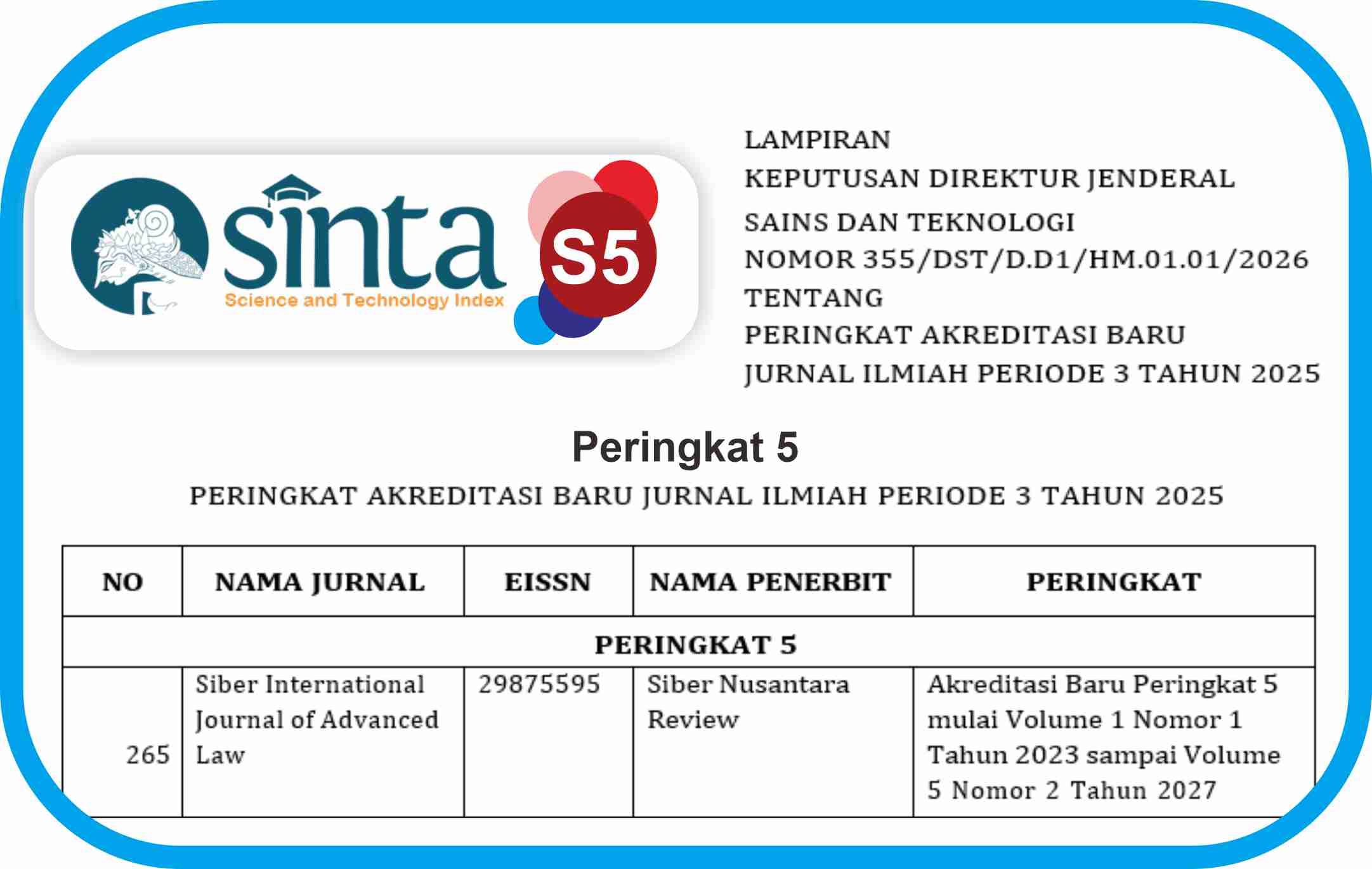
- The author acknowledges that the Siber International Journal of Advanced Law (SIJAL) has the right to be the first to publish under a Creative Commons Attribution 4.0 International license (Attribution 4.0 International CC BY 4.0).
- Authors can submit articles separately, arrange the non-exclusive distribution of manuscripts that have been published in this journal to other versions (for example, sent to the author's institutional repository, publication in a book, etc.), by acknowledging that the manuscript has been published for the first time at SIJAL.