ESG Disclosure, Political Connection, And Firm Value: An Empirical Analysis
DOI:
https://doi.org/10.38035/sijdb.v4i1.387Keywords:
ESG Discloure, Political Connection, Firm Value, Tobin's Q, LQ45 IndexAbstract
This study aims to analyze the effect of ESG (Environment, Social, Governance) disclosure and political connections on firm value. The object of this study is companies listed on the Indonesia Stock Exchange and included in the Liquid 45 Index (LQ45) list in 2022-2024. ESG disclosure is measured based on the Global Reporting Initiative Standard checklist, while political connections are measured by the ratio between the members of the board of commissioners and directors who are politically connected to the total members of the board of commissioners and directors in the company. Meanwhile, firm value is measured using the Tobin’s Q calculation method. This study uses a purposive sampling method with a sample of 39 companies. The analysis was conducted using panel data regression. The results of the study show that ESG disclosure and political connections have no effect on firm value, which indicates that sustainability signals and political affiliations have not been fully appreciated by the market as drivers of fundamental company value in the LQ45 index.
References
Barney, J. (1991). Firm Resources and Sustained Competitive Advantage. Journal of Management, 17(1), 99-120.
Bashatweh, A., et al. (2024). Impact of ESG disclosure on firm value relevance. Finance Research Letters.
Brigham, E. F., & Houston, J. F. (2019). Fundamentals of Financial Management (15th ed.). Cengage Learning.
Dinasti. (2023). Pengaruh Pengungkapan Laporan Keberlanjutan terhadap Nilai Perusahaan. Jurnal Akuntansi.
Elkington, J. (1997). Cannibals with Forks: The Triple Bottom Line of 21st Century Business. Capstone.
Faccio, M. (2006). Politically Connected Firms. The American Economic Review, 96(1), 369-386.
Fatemi, A., Glaum, M., & Kaiser, S. (2018). ESG performance and firm value: The moderating role of disclosure. Global Finance Journal, 38, 45-64.
Freeman, R. E. (1984). Strategic Management: A Stakeholder Approach. Pitman.
Hardiningsih, P., Srimindarti, C., Lisiantara, G. A., & Kartika, A. (2024). How does environmental, social, governance disclosure and political connection performance affect firm value? An empirical study in Singapore. Cogent Business & Management, 11(1).
Husnan, S., & Pudjiastuti, E. (2015). Dasar-Dasar Manajemen Keuangan (Edisi Ketujuh). UPP STIM YKPN.
Jensen, M. C., & Meckling, W. H. (1976). Theory of the firm: Managerial behavior, agency costs and ownership structure. Journal of Financial Economics, 3(4), 305-360.
Spence, M. (1973). Job Market Signaling. The Quarterly Journal of Economics, 87(3), 355-374.
Suchman, M. C. (1995). Managing Legitimacy: Strategic and Institutional Approaches. Academy of Management Review, 20(3), 571-610.
Wu, Y., et al. (2024). Is ESG performance a value driver for Australian firms?. Australian Journal of Management.
Downloads
Published
How to Cite
Issue
Section
License
Copyright (c) 2026 Rinaldi Anggoro Ekasaputra, Fitri Purwiyanto, Dian Kurniawati, Andhika Ahmad Putra

This work is licensed under a Creative Commons Attribution 4.0 International License.
Copyright :
Authors who publish their manuscripts in this journal agree to the following conditions:
- Copyright in each article belongs to the author.
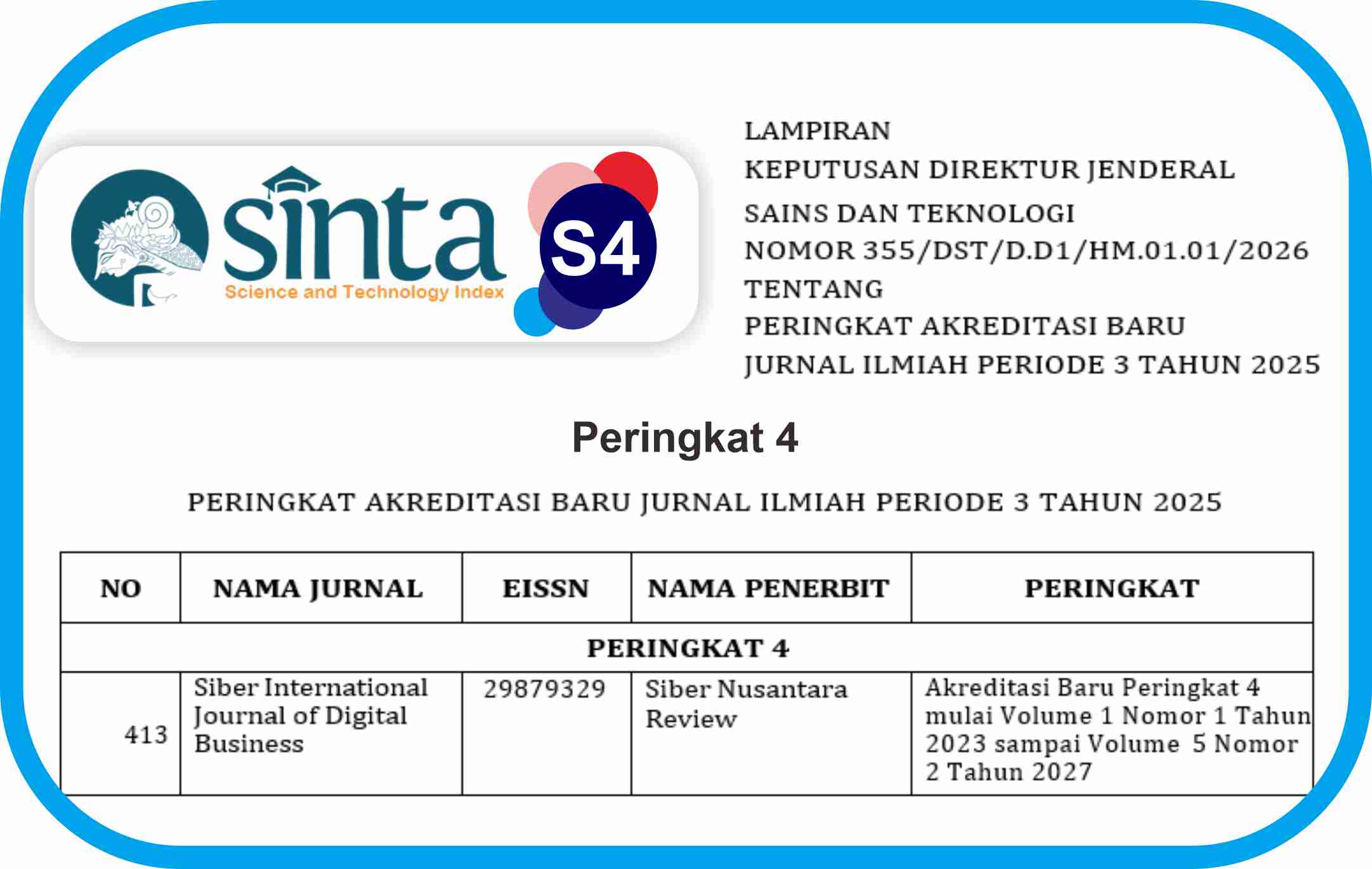
- The author acknowledges that the Siber International Journal of Digital Business (SIJDB) has the right to be the first to publish under a Creative Commons Attribution 4.0 International license (Attribution 4.0 International CC BY 4.0).
- Authors can submit articles separately, arrange the non-exclusive distribution of manuscripts that have been published in this journal to other versions (for example, sent to the author's institutional repository, publication in a book, etc.), by acknowledging that the manuscript has been published for the first time at Siber International Journal of Digital Business (SIJDB).